
If we accept that a soul is eternal and therefore of infinite value, to be involved in God's work of salvation must be the greatest honour we could ever have. It's everlasting in significance and nature, and completely selfless. Is there any greater work that you could do or participate in? Perhaps our prayers for the salvation of souls is the sweetest God ever hears.
Sunday, 28 February 2010


The Burden of Souls
I've been reading up on the Whitefield and Wesley revival in the 18th Century for a short talk that I'm doing at our church prayer meeting next week. The most immediate observation you can make is this – it's largely known as the 'Whitefield and Wesley' revival. It's God and man working together to bring salvation.
Salvation belongs to God, and you can't overestimate God's sovereignty. But you can totally underestimate man's role. We're his instruments, we're the men on the ground. Does God allow his plans (even for salvation) to be frustrated and delayed by us? I think the answer has to be 'yes'. 2 Peter 3 talks about us having the ability to actually speed Christ's return. It must also follow that we can choose to not speed Christ's return. We have a significant effect, and burden, for the salvation of souls.
"You ought to live holy and godly lives as you look forward to the day of God and speed its coming."
2 Peter 3: 11-12
"Salvation belongs to our God, who sits on the throne, and to the Lamb."
Revelation 7:10
"How, then, can they call on the one they have not believed in? And how can they believe in the one of whom they have not heard? And how can they hear without someone preaching to them? And how can they preach unless they are sent? As it is written, "How beautiful are the feet of those who bring good news!"
Romans 10: 14-15
Hudson Taylor Converted By Prayer
Do we completely underestimate the power of prayer in converting a soul? Reading the account of Hudson Taylor he seemed to have been converted almost entirely by the earnestness and consistency of prayer by his sister and his mother. In the hours preceding his conversion the prayer was prompted and directed by the Holy Spirit himself. Here's an edited extract, picking out the best bits from the book on pages 16-18:
- I turned over a basket of pamphlets and selected from amongst them a Gospel tract that looked interesting, saying to myself, 'There will be a story at the commencement and a sermon or moral at the close. I will take the former and leave the latter for those who like it.'
[...]
Little did I know at the time what was going on in the heart of my mother, seventy or eighty miles away. She rose from the dinner table that afternoon with an intense yearning for the conversion of her boy; and feeling that, absent from home and having more leisure that she could otherwise secure, a special opportunity was afforded her of pleading with God on my behalf. She went to her room and turned the key in the door resolved not to leave the spot until her prayers were answered. Hour after hour that dear mother pleaded, until at length she could pray no longer, but was constrained to praise God for that which His Spirit taught her had already been accomplished, the conversion of her only son.
[...]
I in the meantime had been lead in the way I have mentioned to take up this little tract, and while reading it was struck with the phrase: 'The finished work of Christ'.
[...]
'What was finished?'
And I at once replied, 'A full and perfect atonement and satisfaction for sin. The debt was paid for our sins, and not for ours only, but also for the sins of the whole world.'
Then came the further thought, 'If the whole work was finished and the whole debt paid, what is there left for me to do?'
And with this dawned the joyful conviction, as light flashed into my soul by the Holy Spirit, that there was nothing in the world to be done but to fall down on one's knees and, accepting this Saviour and His salvation, praise Him for evermore.
[...]
When mother returned a fortnight later I was the first to meet her at the door and to tell her I had such glad news to give. I can almost feel that dear mother's arms around my neck as she said, 'I know, my boy.'
[...]
My mother assured me that it was not from any human source she had learned the tidings, and went on to tell the incident mentioned above. You will agree with me that it would be strange indeed if I were not a believer in the power of prayer.
Nor this was all. Some time after, I picked up a pocket-book exactly like my own and, thinking it was mine, opened it. The lines that caught my eye were an entry in the little diary belonging to my sister, to the effect that she would give herself daily to prayer until God should answer in the conversion of her brother. One month later the Lord was pleased to turn me from darkness to light.
Brought up in such a circle and saved in such circumstances, it was perhaps natural that from the commencement of my Christian life I was lead to feel that the promises were very real, and that prayer was in sober matter of fact transacting business with God, whether on one's own behalf or on the behalf of those for whom one sought His blessing.
Biography of James Hudson Taylor, pages 16-18.
Saturday, 21 November 2009
Father Skills
It's interesting to read how totally influential the role of James Taylor was in shaping the life of his children, and in particular his son, James Hudson Taylor, who was one of the first missionaries to China. I guess it's an obvious point: the apple never falls far from the tree. Whether you like it or not, your character will be replicated in your children, for better or worse. I really feel God is saying "work on your character now, for shortly you'll be a father".
The thing about James Taylor is that he lead a very attainable life, one which you can actually see yourself leading. From the biography he appeared to be a great man leading a regular life. Nothing about it was overly remarkable. He was diligent, disciplined, loved God and loved his family. And in it he produced Hudson Taylor who was off the scale in the purposes God used him for. Hudson Taylor is one of the sole reasons why there's now 40 million Christians in China, when previously there were none. His dad, James Taylor, set a great standard for fatherhood.
Below are excerpts describing James Taylor from the 'Biography of James Hudson Taylor' by Dr. and Mrs. Howard Taylor; pages 10 to 14.
- A gifted speaker, he gave much care to the preparation of his discourses. He was an excellent chemist, too, and as a business man he was highly respected. So scrupulous was he in financial matters that he made it a rule to pay every debt the day it fell due.
'If I let it stand over a week,' he would say, 'I defraud my creditor of interest, if only a fractional sum.'
Possessed by a profound conviction of God's infinite faithfulness, he took the Bible very simply, believing it was of all books the most practical if put to the test of experience.
The children lived in touch with their father almost as much as with their mother, and he felt himself no less responsible for their training. Though he was stern and even quick-tempered at times, the influence James Taylor exerted in the life of his son can hardly be over-estimated. He was decidedly a disciplinarian. But without some such element in his early training who can tell whether Hudson would ever have become the man that he was? With James Taylor, to keep the children moderately happy and good-tempered was not the point. He was a man with a supreme sense of duty. The thing that ought to be done was the thing he put first, always. Ease, pleasure, self-improvement, had to take whatever place they could. He was a man of faith that went hand in hand with works of the most practical kind.
Family worship he conducted regularly, after both breakfast and tea. Every member of the household had to be present, and the passage read was explained in such practical fashion that even the children could not fail to see it's application. He was very particular about giving them the whole of the Word of God, omitting nothing. The Old Testament as well as the New was taken in regular course, and at the close of every day's reading the date was carefully entered in the family Bible.
He explained to them the necessity for maintaining the life of the soul by prayer and Bible study, as the life of the body is maintained by exercise and food. To omit this was to neglect the one thing needful. He spoke of it frequently as a matter of vital importance, and arranged for everyone in the house to have at least half an hour daily, alone with God. The result was that even the little ones began to discover the secret of a happy day.
China held the first place in their father's sympathies, and he often used to lament the indifference of the Church to its appalling need. It especially troubled him that the denomination to which he belonged should be doing nothing for its evangelisation.
Working Backwards
I watched the film "Knowing" last week (the film with Nicolas Cage, with the picture of the world in meltdown). It was a rubbish film so don't watch it! But one part really stuck out. It was a scene where we encountered a woman who had known the exact date of her death all her life. She was a young woman and the date was close at hand. And it was accurate to the exact day.
If we knew our exact death date, like "Thursday 10th October 2019", that would change everything. After you got over the initial freaking out period, you would probably plan everything around that date. You might think of everything you wanted to do and work backwards from the day you die.
When you're young you don't think like that. We're naive enough to think that time is on our side and we'll actually do something with our lives later on. But maybe working back from our death is the exact approach we need to take. How do we want to serve God for the next 50 or 60 years? What do we want to achieve in the next three years? Maybe we need to put actual dates in the diary and work backwards. Otherwise we'll wake up when we're 60 and say an almighty "D'oh!".
Trajectory
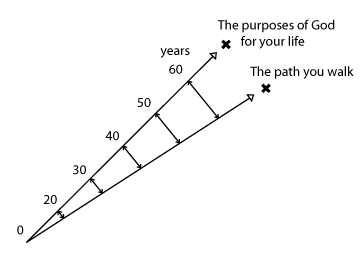
"For we are his workmanship, created in Christ Jesus for good works, which God prepared beforehand, that we should walk in them."
Ephesians 2:10
This is nothing to do with salvation (which is a free gift by grace alone); it's about the purposes of God for your life, the path you walk and the works you actually complete. It's like you can start out walking the path and completing the works God prepared for you to do. But maybe something in your trajectory is slightly off.
Maybe it's something in your mindset, habitual sin, or a lack of zeal. Slowly but surely, if you don't course-correct, you end up miles off course. You might not even notice until you're 40 or 50, and you realise that you've missed much of the purposes God had for your life. The gap from what might have been is larger than ever. And perhaps unobtainable.
James Hudson Taylor seemed to course-correct very early on. And he walked this way throughout his life. His trajectory was probably very very similar to God's plan A for his life.
At church last Sunday (15.11.09) Andrew Wilson was speaking and read a verse from Genesis 5. It was 5:23-24 and reads "all the days of Enoch were 365 years. Enoch walked with God, and he was not, for God took him".
That key phrase for me was "Enoch walked with God". It fires off a real ache in your gut. A real desire to have that. If there was one line written about you after you're gone surely it would be "[your name] walked with God".
James Hudson Taylor and the
threat of a mediocre Christian life
I've just started re-reading the Biography of James Hudson Taylor by Dr. and Mrs. Howard Taylor, which I first read when I was about 19. It's without a doubt one of the best books I've ever read. Unfortunately it's out of print, but I got an old copy off Amazon.co.uk for £2.75. Not bad!
I'm on chapter 1, which details his teenage conversion to Christ in the summer of 1849. What follows is almost an immediate cooling off period from the emotion, passion and joy of his conversion; and the onset of lethargy.
What I find incredibly impressive is how utterly devastated he was by the threat of a mediocre Christian life. He was horrified with his lack of desire to pray and read his bible. He was also desperately aware of the sin in his life, and his failure to overcome it.
But how he totally blew past it. He ended up pleading with God. And God answered – by giving him his life's mission and sending him to China. And yet at this point he's a 17 year old lad who's only been a Christian for a few months. Quite remarkable.
Below are extracts I pulled from pages 19 to 23 which detail this account:
- The joy in the Lord and in His service was not the only experience as summer passed away. Coldness of heart crept in, forgetfulness, indifference. Somehow there seemed to be a gap between the power of the Lord Jesus to save 'to the uttermost' and the needs of everyday life in shop and home. The good he longed to do he did not, and the evil he hated too often had the mastery.
At such times two courses are open to the perplexed and troubled soul. One is to abandon the ideal, and gradually sink down to a low level Christian life is which there is neither joy nor power. The other is just to go on with the Lord, and because of His 'exceeding great and precious promises' to claim complete deliverance not from the guilt only, but also from the mastery of sin.
Nothing less than this could satisfy Hudson Taylor. Conversion with him had been no easy-going assent of the mind to abstract creed. The Cross of Christ had cut him off for ever from the old life, and from rest in anything the world could give. Nothing could satisfy him now but unbroken fellowship with God. Hence times of spiritual lethargy were and indifference were alarming. He could not take backsliding easily. It was nothing less than full deliverance upon which he had set his heart – real holiness, and daily victory over sin.
Outwardly things were much as usual, but inwardly he was almost driven to despair. A deadness of soul had begun to steal over him. Prayer was an effort and the bible devoid of interest. Christmas was close at hand and business correspondingly pressing. There seemed no time for quiet waiting upon God, even had the desire been present. But it was not. At times a terrible fear assailed him, that he was drifting he knew not whither and might miss the purpose of God for his life now, if not hereafter.
What was it that kept him from the life for which he longed? What was the secret of his frequent failure and backsliding in heart? Was there something not fully surrendered, some disobedience or unfaithfulness to light? Fervently he prayed that God would show him the hindrance whatever it might be, and enable him to put it away. He had come to an end of self, to a place where only God could deliver, where he must have His succour, His enlightenment, His aid. It was a life-and-death matter. Everything seemed at stake. Like one of old he was constrained to cry, 'I will not let thee go except thou bless me.'
And then, alone upon his knees, a great purpose arose within him. If only God would work on his behalf, would break the power of sin and save him, spirit soul and body, for time and eternity, he would renounce all earthly prospects and be utterly at His disposal. He would go anywhere, do anything, suffer whatever His cause might demand, and be wholly given to His will and service. This was the cry of his heart; nothing held back – if only God would deliver him and keep him from falling.
'Never shall I forget', he wrote, 'the feeling that came over me then. Words can never describe it. I felt I was in the presence of God, entering into covenant with the Almightly. I felt as though I wished to withdraw my promise, but could not. Something seemed to say "Your prayer is answered, your conditions are accepted". And from that time the conviction never left me that I was called to China.'
Sunday, 15 November 2009
Same old stuff
"If you're not satisfied with the permanent output of your life it could be that you're just spinning your wheels, never engaged in what really counts."
G Campbell White
Most of life just seems to be dealing with the same old stuff: busyness, temptations, struggles, tiredness and such. What sparked off this thought was reading my journal from 5 years ago. I read it, and I realised it's all the same old stuff! Over and over, round and round. It's easy to think "when I get past this issue [insert your issue] life will be better and I can really focus". But maybe those same struggles will be there for the rest of our lives. Maybe we'll never get past them, maybe we can only get on top of them.
Maybe we have to shape-up and realise that all of life is a fight. Rather than be all overcome, living a half-hearted Christian life, we have to get on top and beat all of that stuff into submission. Otherwise, in 20 years time, it's going to be the same old story.
Again, it seems to come down to this whole analogy of a fight, or a war. It's so easy to forget, yet so prominent in the bible:
"the whole world is under the control of the evil one"
1 John 5:19
"For our struggle is not against flesh and blood, but against the rulers, against the authorities, against the powers of this dark world and against the spiritual forces of evil in the heavenly realms."
Ephesians 6:12
The route word of "disciple" is "discipline"
Sometimes I think that we, in the love of the teachings on grace, are so afraid of being legalistic that we fail to be disciplined. We're so scared of having a structured, regimented approach to reading the bible and prayer that we only do them when we're in the mood. We inevitably forget about them altogether and lead a sloppy Christian life.
But then, the whole point of the Great Commission is to "go and make disciples", to make followers of Jesus who are disciplined. Being a Christian is like walking a narrow path along the summit of a great ridge. There's slopes either side, and the place you want to be is right in the middle.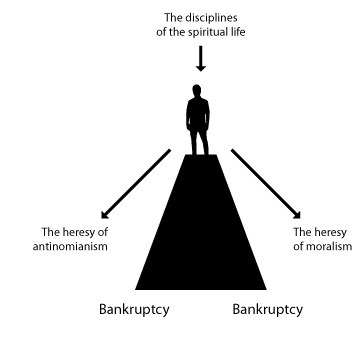
Sometimes we back so far off from legalism (or moralism) that we can slip off the other side. Surely diligence in the spiritual disciplines is a very good thing. You don't earn any holy points by doing them. They simply put you in the right place to hear from God.
Sunday, 8 November 2009
Your perception of things

It seems to be that your perception of things is never quite right. Through the process of thought, pretty much everything gets distorted to one degree or another. Like how your work college or spouse will react to a particular issue. Certain issues become much bigger in your mind, but when they actually play out in reality, it's different to what you expected, and not a big deal.
Other issues are perceived smaller. Maybe our perception of sin and particular habits become too small in our minds. They're placed to one side, when really they have a far greater influence in our lives than we would like to admit.
This all leads to a question – do we ever perceive things clearly, as they actually are? Or are we always off?
Perhaps your mind and your patterns of thought is like a lens that distorts. And perhaps the written word of God is like a lens that corrects. We only see things as they are when we come back to the bible.
Sunday, 1 November 2009
Loneliness
"The open discussion of loneliness is the most taboo subject in the world. Forget sex, politics or religion or even failure, loneliness is what clears out a room"
Douglas Coupland, Miss Wyoming, 1999
Sounds about right.
Sunday, 25 October 2009
If you don't have a budget,
you won't have any money
Working on your accounts is like fine tuning an engine. If it's done well you can get an awful lot out of it. Life becomes much more satisfying and you have a real peace of mind about what you spend and what you give to God. When every penny is assigned as 'worship', suddenly, every day has a new sense of purpose behind it. A little bit of discipline can really free you up.
On the other hand, if you pay no attention to it, ignore it, bury your head in the sand; all sorts of problems develop. Your finances become wasteful and inefficient. Money is frittered away and you can easily accumulate debt. Your peace of mind goes out the window, your soul feels uneasy.
"A little sleep, a little slumber,
a little folding of the hands to rest-
and poverty will come on you like a bandit
and scarcity like an armed man."
Proverbs 24:33-34
I've heard a lot of sermons on why you should give, but very few on how to give. I thinks there's a general assumption, somewhere along the line, that people actually know how to budget. For years and years I didn't have a clue. It's one of those things that seems obvious when you know how. But if no one has taught you, you're lost at sea. You're stumbling around in the dark.
But one thing that is clear – when you work so hard to earn cash, surely wisdom should govern its distribution. Hard earned cash that is frittered away on things that don't matter is a life consumed with toil, debt and fruitlessness. Effectively managing your accounts is one of the most important elements of your life's work.
At my life group, I plan for us to share effective ideas on how we give to God and manage our accounts. In this, I'm making the assumption that we know why we should give and that we want to be a cheerful give. Here are some of my own techniques I've used in the past, and the ones my wife and I are currently using.
1) Account for every penny.
When I first decided to really tackle my accounts head-on, I decided to write down every penny I spent. To my horror I realised that in that very month I had spent over £300 on socialising and convenience foods. Going out to pubs, eating out, trips to the cinema, drinking Coca-Cola. It honestly didn't feel like I had spent that much. It 'felt' like I had spent about £100. It's easy to forget what you did last week. And it's incredible how expenses add up.
Question: If an accountant was to examine your finances, would he find that Jesus was a priority?
In a lack of discipline I would spend too much on clothes and CDs. And then in a lack of finances I would fail to give God anything. If you're budgeting for the first time, going through the last 6 months of bank statements can be a real eye-opener, and quite painful.
2) Develop a list of averages.
Keep all your receipts and tally up average amounts on a monthly basis. Over the course of a year you can work out average expenses for pretty much everything. Here's a list of what my current averages include:
- – Church Giving
– Food
– Clothing
– Socialising
– Rent
– Car Insurance
– Car Maintenance
– Car Servicing
– Car Tax
– Home Insurance
– Home Expenses
– Dentist
– Glasses
– Gym
– Car & Bike Repayments
– Life Insurance
– Mobile Phone
– Sky
– TV license
– Card Protection
– Holidays & Special Events
– Weddings
– Stag Do's
– Haircuts / Beauty
– Presents
– General savings
Developing this list helps you learn exactly what you need to budget each month and pay into savings. In particular, you need to work out all the seemingly random and unexpected expenses (such as weddings and stag-do's). Otherwise, you get caught out.
In this, highlight all the items on the list that you would regard as 'worship' to God. Interestingly, most of the items are necessary in life (most, not all!). And a lot have a question mark over them. These are the open-ended ones, such as food, clothing, socialising, holidays, presents, phone tariff and type of vehicle. They can all be governed with wisdom and diligence, or they can be self indulgent and reckless. These will make or brake the bank.
"So whether you eat or drink or whatever you do,
do it all for the glory of God."
1 Corinthians 10:31
3) Determine the open-ended expenses.
- – Food
– Clothing
– Convenience foods
– Socialising
– Presents
– Random purchases
These are the day-to-day expenses that can go off the scale if left unchecked. The most effective way that Lynsey and I have dealt with this is to have a weekly cash allowance. We worked out that we get £25 each per week, and out of that we have to cover all of the above. All birthday, Christmas, wedding presents, clothes etc come out of this. We have to save up in advance for lots of these.
We've found it to be a brilliant method as when the money in your wallet is gone, that's it for the week. You know you won't go over budget. And anything you buy, you know you can afford and you feel good!
4) Keep on top of it.
It only takes 30 minutes every week or so. Regular updates to your charts means you can remember what the expenditures on your bank statements relate to. Constantly updating your averages and budget keeps things in check. Apparently the very act of keeping accounts improves your spending, as you're mindful of your finances.
5) Find peace about your church giving.
It's not about 10%, it's about generosity. There's nothing in the New Testament about giving 10%. In reality, when you study the early church, they all appear to give much more than this. Old Testament tithing was effectively the Jewish taxation system, and was actually about 25% of their total income per year. The 10% figure is just a reference to the largest part.
"Each man should give what he has decided in his heart to give, not reluctantly or under compulsion, for God loves a cheerful giver."
2 Corinthians 9:7
Would you ever want a present off a friend who gave it reluctantly because they felt they had to? You would probably feel awkward, and wish they hadn't felt obliged. In stark contrast, how much would you love to get a gift from a friend who was really excited to give it to you, and couldn't wait to see the look on your face! You would love it.
I think each one of us has to find the right level of giving and the right heart that produces this excited attitude. In one sense, the cost has to be there. The gift has to be worth something to us to contain meaning; but not to the level that it breaks the bank and causes us to freak out.
What feels too low? What feels too high? I think you can home-in on a figure that your heart really feels at peace with, that makes your faith muscles stretch but not tear.
Any thoughts?
Tuesday, 13 October 2009
If you just stopped moaning you might actually be happy
I felt God really speak to me clearly this week. And he said that I ought to stop moaning about everything. Life is hard work, yes. And you don't get much time to yourself and you're often quite tired. All good points, but you constantly moan!
What sparked it off was watching an older work colleague of mine who's had a tough week, and was sick, but was cheerful all the way through it. I realised that if I can do what I do, but in a cheerful spirit, I would be an awful lot happier. And my works would be a lot more pleasing to God.
"If I give all I possess to the poor and surrender my body to the flames, but have not love, I gain nothing."
1 Corinthians 13:3
It's like, if I short-curcuited that whole meditation process where I get really manked-off with everything, my whole outlook on life would lift dramatically. It's not so much the moaning, which is really just the symptom, it's the meditation process that's the real issue. The process of churning things in your mind over and over.
"As a man thinks in his heart so is he"
Proverbs 23:7
Anyway, a good bit of repentance is the order of the day. Which makes me think. Repentance almost makes sense to be done as a weekly habit. Surely lots of little acts of realignment with God are much better than the big dramatic acts of repentance that only occur when your whole life is devastated. A thought to dwell on.
Monday, 12 October 2009
The Bible: the Perfect Word of God?
"As Jesus Christ was totally human and totally divine, so is the bible. All scripture is witness to God, given by divinely illuminated human writers, and all Scripture witnessing to himself in and through their words."
ESV Study Bible, Crossway, p2569
"All Scripture is breathed out by God and profitable for teaching, for reproof, for correction, and for training in righteousness, that the man of God may be competent, equipped for every good work."
2 Timothy 3:16-17
It seems there are two essential views inside Christianity. The first is that every word is the breath of God, written by men, directed by the Holy Spirit. It is a divine work and completely free from error. The second is that it's a collection of 'trustworthy' books. Like reading someone's diary. Essentially good but ultimately a human work with many flaws, errors and imperfections.
Here's some of my own observations...
Observation #1
Unless the bible is the perfect word of God, completely without error, it's as good as useless. If you don't believe it's perfect, you can pick and choose what to believe, skipping over sections you don't like. You are free to disagree with scripture at any point. It becomes increasingly vague and not very useful. Which is a problem.
Observation #2
The bible reads like the very words of God. I've never read a book like it. It cuts down to your very soul. You're refreshed by reading it. You feel anchored, like you're plugging into the source. There's something within you that seems to confirm that these words are very, very good. I would say this is the Holy Spirit at work in you as you read the bible. Maybe one way of plugging into the Holy Spirit is simply to read your bible.
Observation #3
The actual writings of the bible stretch out over a period of 1500 years. In this period of time over 25% of the written words are prophecy, predicting future events. These events later occur with stunning accuracy. One example is found in Daniel 9:26-26 which foretells the exact date Jesus Christ would come to Jerusalem. The mathematics are staggering when you look into them. There's a real supernatural side of the bible that is grounded in historical fact. That makes it immensely interesting.
Observation #4
According to The Resurrection Factor by Josh McDowell, the death and resurrection of Jesus Christ can be proved in a modern day court of law. This is a claim based on historical evidence which validates the central character of the bible as the son of God.
Observation #5
Ultimately, we believe the bible is the word of God because it claims to be. The most direct claim is 2 Timothy 3:16-17. Nothing else can be higher than the word of God in order to validate it's claim. Historical evidence, reason, experience and such can all point to it, but can never themselves pass judgment on the bible as they are under it.
––––––––––––––––––––
Anyway, it turns out this is rather a massive subject and delving into all the specifics hurts my brain! To check out how the bible was put together, and how God oversaw the whole process, listen to Wayne Grudem on The Authority and Inerrancy of the Bible
Subscribe to:
Posts (Atom)